How to keep productive when travelling

World-travel

A common problem I come across when working with people is that when you have a busy travel schedule it knocks out your usual routine and emails and actions build up, which means you're twice as busy when you return.

So, how do you stay productive?

Plan time at the beginning and end of the day -  to deal with day-to-day actions while you're away or to touch base with the office.

Use Cloud technology to access important documents while you're away - Dropbox and Google Drive are two great ways to share documents across your devices and with your team or clients.

Set aside time to check your emails.  Even a short burst of 15-30 minutes enables you to keep up to date.  Delete any spam and 'ping-pong' emails (those where ongoing conversations are bouncing to and fro) and flag important ones to deal with later or forward them for delegation.

While wi-fi free on a train or plane it's a great time to blast through emails without getting distracted by new one's.  You'll be surprised how much you can get done without your usual distractions and interruptions.

Catch-up on reading.  Time spent waiting in airports and stations is a good opportunity to keep up to date with some of those articles you've put aside to 'read later'.  When you're away from your usual routine it also provides time to think up new ideas and opportunities.

Delegate as much as possible while you're away, so the day to day running of the business can carry on in your absence without needing your constant input.  You can then focus on the purpose of the trip without interruptions.

If you have an assistant - they can filter and prioritise your emails for you and in some cases respond on your behalf, so you have less to deal with while you're away or on your return.

Review and update at the end of each day.  Make a note of any follow-ups and actions as you go along, so there'll be less to do when you get back.

While you want to maximise your time while you're away, give yourself time to recover from a long journey or after a busy day of meetings.

Make sure you allow catch-up time on your return.  Don't schedule a busy morning of meetings on your first day back - keep your diary free for at least an hour or two, so you can plan your week/day, set aside time for the follow-up and actions that have come out of your trip.

Manage your travel schedule - I've seen people who frequently plan back-to-back trips, hardly pausing for breath between one trip and the next.  Be realistic about how many days travelling you can practically managed in a week or a month while still staying productive and finding time for your family and friends when you get back.

World-travel (Photo credit: Wikipedia)
Enhanced by Zemanta

Increase your company's productivity

What do you need to change or do differently that will make a big difference to you or your organisation?

What are the key habits your company needs to adopt which will increase your overall productivity and enable everyone to work better and more efficiently?

While I often work with individuals I also run workshops for teams and organisations. There are habits and key practices that many organisations could implement that would have a positive impact on the productivity of the whole organisation.

Two key areas which are a great source of time-wasting are email and meetings.

You can read the rest of this newsletter article "Increase your company's productivity" or subscribe to the free monthly newsletter.  Get "7 Essential Time Tips For Instant Results" when you register.

The myth of Inbox zero

GTD - my inbox (before)

Email is one of the top things that gets in the way of being productive - although it's a tool in itself, it's also a source of great time wasting.

Not only because of the shear volume of emails you receive on a daily basis but because of the time you spend dealing with it.

So having your Inbox at zero sounds great.

In reality it's not about getting your Inbox to zero but how you deal with email.

Let's face it, it's easy to get your Inbox to zero if you just move everything out to a series of folders but it doesn't mean you've actually dealt with it.

Some people will have folders named 'Action', 'Follow-up', 'Pending' etc.  Now you have more folders to check each day which is OK if you're organised but there's a pretty good chance you'll forget and end up with overdue items in your 'Action' folder.

Your email relates to your work.  Therefore any email you receive is part of a project your working on, clients you're working with or something else to do with your work ... right?

Getting back in control of your Inbox means being organised and having a structure and routine for dealing with it.

Don't take it personally - don't get too attached to your emails.  It's probably not essential that you read every word.

Start at the source - can you stop the email arriving in the first place?  Unsubscribe 

There are more effective ways of managing communication between teams rather than using email.

 (Photo credit: kogakure)
Enhanced by Zemanta

You don't have to answer it

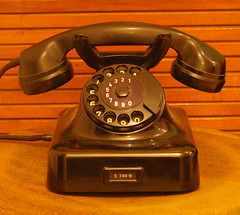
Telephone

How often do you call someone on the phone whether on their landline or more often their mobile and having answered it, they then say they can't talk ... they're busy ... with someone ... in the middle of something?

I hear it quite often.

If that's the case, you don't have to answer the phone - especially if you're in a meeting or with someone.

Good meeting etiquette and showing respect to the person/people you're with is that you prioritise them over anything else - especially interruptions from a phone call.

Is the interruption more important that the person you're with or the task you're working on?  If it is - fine, go ahead and answer it but let them know.  If not, let it go through to voicemail and call them back when it's more convenient and you're free to talk.

If you're expecting an urgent call - say so.  Otherwise, remember to switch your phone off or put it on silent when you're with someone.

(Photo credit: plenty.r.)
Enhanced by Zemanta

Eating lunch at work is bad for you

sandwich

Yet more research on the detriment of not taking a proper lunch break.  Especially if you're one of the 54% of office workers who work through your lunch break.

We have a culture of working long hours - there's almost an unofficial competition as to who can work the most hours, get in first and leave last.

In some organisations there's undue pressure to be seen to be working at all times or your job could be at risk - that means either skipping lunch or eating it at your desk.

One in thirty feel under pressure to eat their lunch at their desk or feel self-conscious if they go out for lunch.

We all need to take more breaks during the day.  It doesn't take research to realise that sitting at your desk all day is bad for you.  Not only will your posture suffer but keeping still for long periods doesn't help the circulation or concentration.

Take a break from your desk - try a change of scenery and preferably get out and get some fresh air.  If you have the option of getting some exercise - then do so, even if it's just a walk around the block. 

Eat - and take time to savour what you're eating rather than grabbing a hasty sandwich and dashing back to your desk or skipping lunch completely.

Don't feel guilty.  You're entitled to regular breaks in your working day.

You'll be more productive the more breaks you take.  The longer you work on one particular task, the less effective you're likely to be.

A happier, healthier and more productive workforce take fewer days off sick and staff turnover reduces, so it benefits the company and reduces costs.
Enhanced by Zemanta

After the workshop is over ...

Meeting room

You've just come back from a really inspiring workshop - full of great ideas and you have a list of all the tips and information you've absorbed, enthused with all the things you're going to do and change.

You get home - it's been a long day, so you grab a bite to eat, switch off and relax.

The next day - you add the training folder full of notes to the pile or slot it on to a bookshelf.  You might be thinking about some of the things you learned on the day.

During the course of the next week you might implement a few of the things you picked up with the motivation of your new found enthusiasm but within a couple of weeks you've probably forgotten most of it and you've slipped back into your usual habits and routine.

So, how do you make the intention stick?  How do you make the changes and keep the momentum going until they've become new habits or ways of working or being that you want.

As soon as possible after the seminar, workshop or event - review the material and your notes.  The more often you review the more likely it will stick in your longer term memory.

Set your intention and focus.  What is it that you really want to achieve by making these changes or doing things differently, what is the underlying benefit that you'll get from it (it's often not what you initially think)?

Don't try to change too much at once - you'll feel overwhelmed and more likely to stop doing everything.  Just make one small change at a time.

Make it easy - how are you going to fit these new changes into your work or lifestyle?  If it's too complicated or expensive it's less likely to happen.  Ironically, you might want to make the changes but you're 'too busy' ... 'you'll do it later' and of course 'later' never happens.

Commit to taking action.  If you've come away with a list of 'to-dos' add them to your daily, weekly, monthly action list - set aside time for them.

Follow-up - both with yourself and others.  If you've committed to doing something, review your progress on a regular basis - you're less like to fall off the wagon and more likely to stick with it.

The key to success and the way to get the greatest benefit from any training or self-improvement course is to make yourself accountable, constantly review your progress and keep motivated.

(Photo credit: Wikipedia)

Lower productivity in open plan offices

Cubicles in a now-defunct co-working space in ...

A recent study shows that working in open plan offices reduces performance and increases fatigue.   It's not an easy environment in which to be productive.

Easy to put up, easy to reconfigure, there is no privacy and little to stop noise, voices and phones carrying across the office space.

You're separated from from your neighbour by a short partition - in some offices the height and construction may vary but you can still hear the conversation or ad-hoc 'desk meeting' going on next door whether or not you want to or if it's relevant to you.

We all know people who have especially loud voices or who, from their own sense of self-importance, want everyone to hear their conversation.

As a reformed cubicle worker, and Dilbert devotee - I spent years working in the open plan office environment, so I'm aware of what does on.

An open-plan office environment supposedly improves communication but it does mean you suffer far more from distractions and interruptions.  People can see you're 'in' and won't think twice about interrupting.

Some people can work in a noisy environment, others can't.  Some tasks need focus and attention, others don't.

  • Book a meeting room or arrange to work from home if you need quiet undisturbed time.
  • Create boundaries (not necessarily physical) around your time and space.  If you get interrupted at your desk - manage the interruption - do you want to deal with it or can you ask them to come back later?
  • Respect other people in and around your space - if you're having a 'chat' do it away from where you may be disturbing others.
  • If you need to have a meeting with colleagues either book a room or be aware of disturbing others around you.
  • Try noise cancelling headphones or playing 'white noise'.  If you're listening to music - don't have it too loud to block out the office noise, you could damage your hearing.

Related articles:


(Photo credit: Wikipedia)

Enhanced by Zemanta