Get A New Perspective - Free Strategy Session

Spring is in the air. The days are getting longer and out in the garden, things are definitely starting to break into bud.

Spring!Image by Audringje via FlickrNow is a great time to take a step back, get a fresh perspective, sweep out the cobwebs and put the spring back in your step.

If you want to spend less time at work and more time enjoying the Spring/Summer sunshine and long weekends without the worry and stress of work - book up a free 30 minute Strategy Session.

Send me an email , a DM or complete the contact form on my website and I'll get back to you to book up a session.

Places are limited each week, so it will be first come, first served.
Enhanced by Zemanta

Seven Top Tips For Working Fewer Hours

The majority of people I talk to will freely admit to working longer hours than they would like. So here are a few of my top tips to help you reduce them:

  1. Decide what time you plan to start and finish.  If you set the intention up front that you're going to finish at a certain time then you're more likely to achieve it.  It will also stop you working until a job is finished.  If you're honest, you probably only work at 60% efficiency.  Increase that to 80% and you'll be able to finish earlier.
  2. Set a time limit.  Most people let time run away with them and work on a job until it's finished.  It you only allow yourself 30 minutes, an hour, half a day ... you may find that you actually get it done and work more efficiently in the time.
  3. Don't over extend yourself.  Another common challenge is to set out with too much on your to-do list that you can't possibly hope to achieve in a day.  Be more realistic.
  4. Reduce your distractions and interruptions - think how many times you get distracted or interrupted in a day.  Phone calls, emails and people 'dropping in'.  If you limit all these distractions and interruptions, you'll easily save an hour a day.
  5. Take control.  Too often we're reacting to whatever or whoever shouts loudest rather than deciding what needs to be done next.  Improve your planning and prioritisation and you'll regain control of your time.
  6. Be selective about where and how you spend your time.  Busy people can often find themselves pulled in too many different directions at once and end up with too much on their plate.  Don't feel you have to say 'yes' to everything.
  7. Chunk your time.  Group similar tasks together and you'll reduce the chopping and changing that goes on when switching between different tasks.  Make a few phone calls all at one time; respond to several emails at once; plan tasks and meetings to reduce travel time.
Find ways to improve your time habits and reduce your working hours - start with a Time Audit.

Today Is 2011 Census Day

As I filled mine in last week, I noted a few questions where things may well have changed in the last 10 years.

What is the address of your workplace?

How many of us now work from home compared with 10 years ago?  More and more people are either setting up their own businesses or deciding to work from home.  The credit crunch, redundancies and technology have opened up the opportunities for home working.  We're also more likely to have changed jobs a few times in the last 10 years.


How do you usually travel to work?

Travelling to and from work can easily add another 2-4 hours a day to the average worker.  Whether they commute by car or train it adds a significant chunk of time to their working day and eats into their personal life.

Travelling to and from work is an increasing source of stress - rush-hour traffic, reliability of public transport and increasing cost.


How many hours a week do you usually work?

Will this have increased for full-time workers?  People are generally working longer and longer hours or having two jobs to make ends meet.  We work longer hours than most of your European counterparts.

I frequently talk to people who will fall into the '49 or more' category.


These are just three of the areas that impact the people I talk to and work with.  So, how have things changed for you in the last 10 years?

Have you switched workplace - do you now work from home?  How long is your average travel journey to and from work and how many hours do you work in an average week?

Oh and of course, now you can complete it online.  How many of you completed your census online and how many of you left it to the last minute?

Enhanced by Zemanta

Networking Tips #6 - Be Prepared

To get the most out of your networking, spend a little time preparing for your meetings.

Get yourself a name badge.  Sometimes networking events will provide you with name badges which gives you one less thing to remember.  A simple one you can slot your business card into is useful, as long as the name on your card is easily readable.  People are impressed with a smart name badge rather than a hand-scrawled sticky label or none at all.

Take plenty of business cards.  Yes, I know that's obvious but people still turn up at events with no business cards or run out because they don't have enough.

Have a notebook and pen with you.  You'll probably want to take notes of who you meet, useful information, opportunities for sharing contacts.  Write it in your notebook on the back of their business card.

Think about what you're going to say.  Not only to the standard question "... and what do you do?" but also to generate conversation with the people you meet.  Practice saying what you do in a clear, concise way. One or two sentences is fine.

Get there on time.  There's nothing worse than arriving late when people are already in full flow.  It's good to arrive early and then you can easily introduce yourself to both the meeting organisers and to the first few people who are likely to be there early.  You'll have a head start on the others.

Carry a business card with you at all times.  You never know where or when you'll have an opportunity to offer help or your services.  It doesn't always happen in organised events.

Where's the most unusual place you've been networking?

Meetings, Meetings, Meetings

Hundreds of hours are wasted in unproductive meetings every day.

Ineffective meetings lead to general dissatisfaction and are listed as one of the top three time wasters. 70% of employees feel they’re unproductive.

Have a purpose for holding a meeting in the first place - know the outcome you want.

Make sure the right people are in the meeting - whether contributors or decision makers.  There's nothing worse than trying to get agreement and another meeting is needed to make the decisions.

Always have an agenda for meetings with a set end time - so many meetings are open-ended with no direction and just drift on too long.

Start and end meetings on time. Have a time-keeper to keep people focused and it's the hosts/chair's responsibility to bring people back to the agenda if discussions get side-tracked.

Decide whether a meeting is the most effective use of everybody’s time? Could the information be better communicated by email, phone call or a report? The purpose and outcome of the meeting should balance the input of time and effort by all those involved.

Use technology to set up meetings using teleseminars, webinars or group conference calls.

Make A Difference: Japan Earthquake Appeal

Last weeks earthquake in Japan is still very much at the forefront of the news.  Yet again we are reminded of the immense power of nature.

Earthquake and Tsunami near Sendai, JapanImage by NASA Goddard Photo and Video via FlickrIt makes all our endeavours and aspirations pale into insignificance.  We might think we are in control, that humans are the most powerful species on the planet but something like this happens and lives are changed in an instant.

Thousands of lives have been lost, whole communities swept aside in a matter of minutes.  Boats, cars and houses flung aside like toys.

It brings home to us all that our safe, secure day-to-day life can change in a moment.  Everything we work for, stress and worry over gets put into perspective at moments like this.

Do something today to help make some small difference to those in greatest need.

Enhanced by Zemanta

March Newsletter: Never Be Late Again

Are you always the last person to turn up at a meeting?

Do you find yourself always rushing to get somewhere and arrive hot and bothered, stressed out by the traffic, public transport or trying to find somewhere to park?

Would you rather arrive cool, calm and collected?


Read the rest of the article and get tips to help you turn up on time, in this month's newsletter, just click here to read it.

Register for the free monthly newsletter for free tips, advice, information and news on how to improve your time management for your business and personal life, direct to your inbox - www.clareevans.co.uk.

Networking Tips #5 - Know What You Want

Know what you want from an event.  Again this sounds like an obvious one but many people turn up at an event and don't really have any expectations of what they want to achieve by attending.

You're spending your precious time and resources on being there, so it makes sense to get the most from it.

This doesn't mean pressing your business card firmly into the hands of everyone you meet.

It doesn't mean giving a sales pitch to as many people as possible.

It doesn't mean speaking to every single person in the room - you'll be lucky if you speak to half a dozen new people at any one event.

If you really want to maximise the number of people you talk to, then go along to a Speed Networking Event.  Here you're more likely to meet everyone who's in the room and at least find out a little about all of them.

Decide what you want before you get there.

- Plan to meet a certain number of new people.
- Plan to reconnect with people you know.
- Plan to meet one or two key contacts if you know who's going.

If you're sent a list of attendees - make a note of who you want to talk to before you get there. Perhaps there are people you recognise or people you'd like to talk to.

International Women's Day

Today is the 100th International Women's Day.

About half of the people I work with are women and the majority are juggling families and business.  Fitting in the school run, supermarket shops, birthday parties, cooking, cleaning, being a wife and mother around running their business.

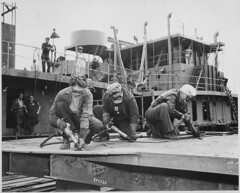
Chippers in a Shipyard [Shipbuilding. Three Wo...Image by The U.S. National Archives via FlickrDespite the changes in women rights and gender equality - women are still the main carer when it comes to bringing up the children.

Although more women work and are found in a variety of careers, take on senior positions and run their own businesses, there's always the difficult choice of family or career.

It's hard trying to balance both and while possible, it takes an immense amount of planning, organisation and support to do it well.

Even high fliers who appear to have it all have had to make sacrifices to get where they are and couldn't do it without a team to support them along the way.

Rarely do I meet a top executive who hasn't regretted not being able to spend as much time with their family while they put in the hard work to get to the top (it applies to men as well).

Work smarter not hard.  Create a better balance that allows you to juggle having a successful business AND enjoying your personal life more.

IWD Special Offer - complete and return your Time Audit today and get a half-price Time Audit Feedback Session - TODAY ONLY!
Enhanced by Zemanta

M.A.D. Want It All And Want It Now

These days we expect to have everything we want and we want it all now.

Strawberries and salad vegetables are available all year round – shipped hundreds or even thousands of miles from half way around the world.

If you see a new outfit, suit or pair of shoes that you can’t afford – out comes the credit card, you can have it now and pay for it later.

How many unworn clothes are hanging in wardrobes or unused gadgets are tucked away in cupboards and drawers that you'll probably never use or throw away in a year or two.

Recycling symbolImage via WikipediaIf something breaks, we don’t even think about fixing it, we just throw it away, go out and buy a new one. Technology changes so fast that things are usually obsolete as soon as we've unwrapped them.

We think it's our right to have the very latest of everything and to have everything new. We don’t want to buy second-hand or make do with hand me downs. But there’s a whole industry built around passing on second hand goods and recycling to those less fortunate - not just on Ebay and Freecycle.

Things don't last either.  My parents are still using things they were given at their wedding – over 40 years ago – not much you can buy these days that will still be working in 40 years time.

How many times have you bought something that breaks down after only a couple of years use or just after the guarantee runs out?

What happened to make do and mend – or saving up to buy things?  A little restraint and patience can’t be a bad thing.
Enhanced by Zemanta